
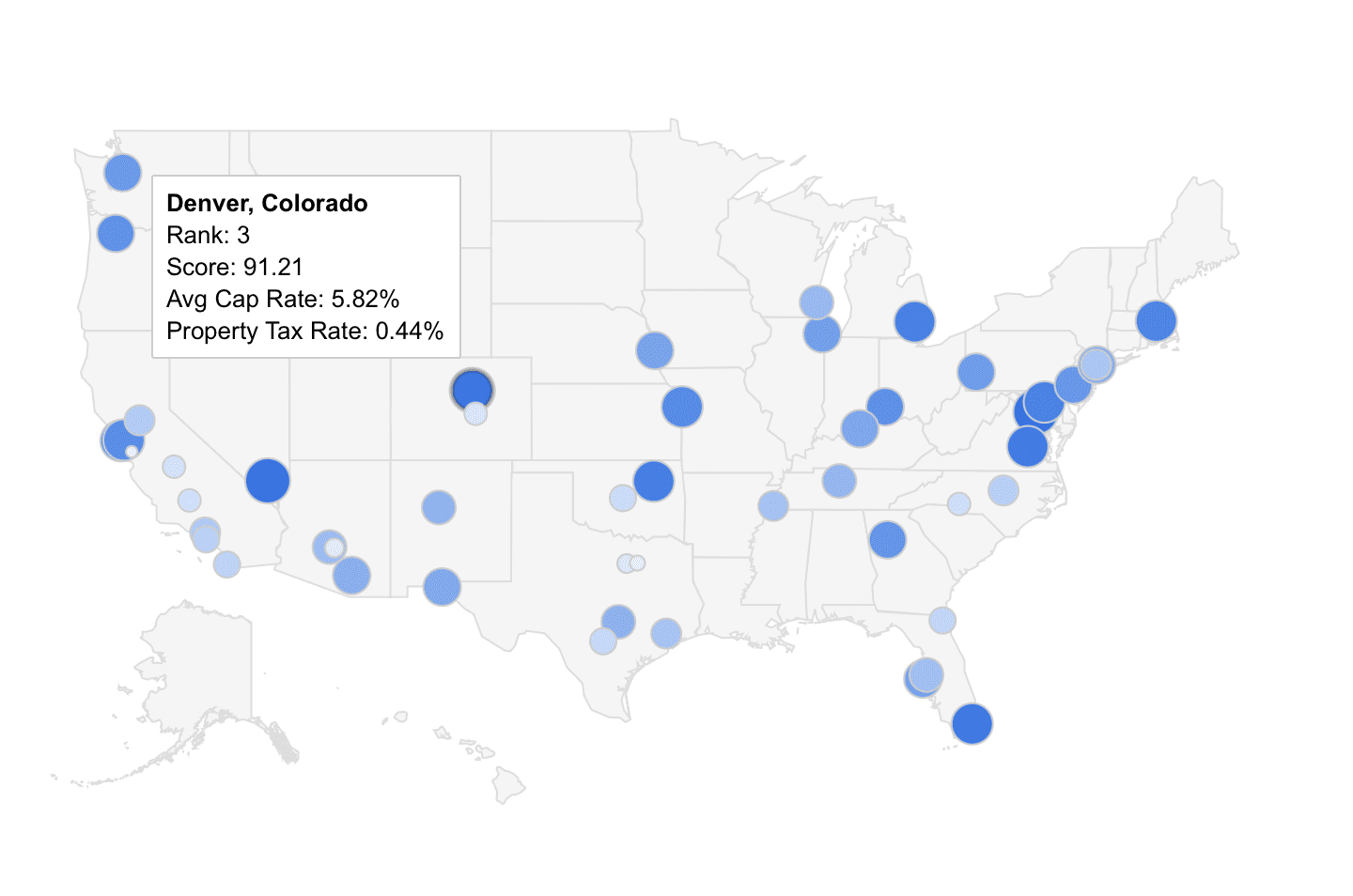
When LoopNet published its 2026 list of the 10 Best Places to Buy Multifamily Property, Denver was one of the top markets in the country, which supports what many Colorado investors already know: Denver is one of the most well-positioned multifamily markets in the country.
However, for investors, it doesn’t matter how high a market is ranked if the fundamentals aren’t in place to deliver. In Denver, they are, although the play has changed in the past two years.
Why Denver Scored Nationally
The methodology used looks at more than just cap rates. It takes a combination of yield, property taxes, quality of inventory, and lifestyle factors that drive demand. Denver’s high ranking is due to several factors that are important to investors:
- Favorable effective property tax structure compared to many peer metros, improving long-term hold performance.
- A deep base of newer Class A inventory, which attracts institutional capital and supports operational efficiency.
- Lifestyle-driven renter demand, including access to outdoor recreation, strong employment sectors, and sustained in-migration from higher-cost coastal markets.
For capital allocators surveying national markets, Denver represents a rare breed of market that offers growth market dynamics without the volatility that has been observed in some overheated Sunbelt markets.
The Current Window: Supply-Driven Repricing
One of the most compelling aspects of Denver as a market today is the timing.
The market has absorbed a record influx of new multifamily products over the last several years. This has led to higher vacancy and rent concessions, especially in the central business district areas. For some owners, this has compressed the near-term return profile.
However, for capital allocators with dry powder, this phase of the market represents a reset in pricing.
Construction starts are down sharply, which means that the supply pipeline is shrinking. As new product deliveries slow, absorption is expected to help rebalance the market:
- Basis opportunities below replacement cost
- Increased seller motivation in certain submarkets
- Ability to negotiate stronger terms amid capital market caution
This is not a distressed market, but it is a rationalizing market. And rational markets provide entry points.
Capital Markets & Strategy Shifts
Transaction velocity has tempered from the peak years of 2021-2022, although Denver remains one of the more dynamic multifamily markets in the country.
Institutional participants continue to target core properties and core-plus properties, while regional buyers and private buyers target value-add opportunities in the suburbs and properties with upside potential and properties ready for lease-up stabilization as supply diminishes.
Cap rates have increased from historic lows, and as a result, yield spreads are more attractive relative to debt costs than in the most competitive parts of the last cycle. For long-term owners, the current market may provide more stable underwriting assumptions than the aggressive pro formas of the low-rate cycle.
Submarket Selection Will Matter
For Denver investors, the trend has become more and more disparate as new supply has begun to cluster in certain pockets of the urban core.
The downtown and RiNo areas have been impacted the most, with increased concessions and slower lease-up. On the other hand, several suburban corridors, with strong schools, public transportation, and large employment centers, have been more stable.
Investors today who are underwriting properties should look at employment density, income growth of renters, and the supply pipeline in a two-mile radius. Flexibility in city planning and zoning should also be considered, as future density and entitlements can significantly affect value.
The diverse economic system of Denver which includes aerospace and technology and healthcare and energy and professional services creates a steady demand for rental properties which persists through all economic downturns.
Strategic Outlook on Denver
Denver’s inclusion as one of the top markets is not about publicity, but about its underlying strengths: tax efficiency, quality inventory, and continued appeal to renters.
The bigger picture for investors is this: Denver is moving from a supply-driven cycle into a normalization cycle. As new deliveries taper and absorption rates stabilize, well-positioned assets purchased at a revised price point could begin to see improving fundamentals in the next 24-36 months.
Few markets present optimal conditions. The best entry points are often found when market narratives revolve around short-term challenges rather than long-term positioning.
The strategic multifamily investor who focuses on 2026 allocations will find that Denver exists as a market which attracts national interest while providing local investment possibilities and which determines investment returns through its market timing instead of its momentum.
Read the full national report here.