

By Katie McKenna,
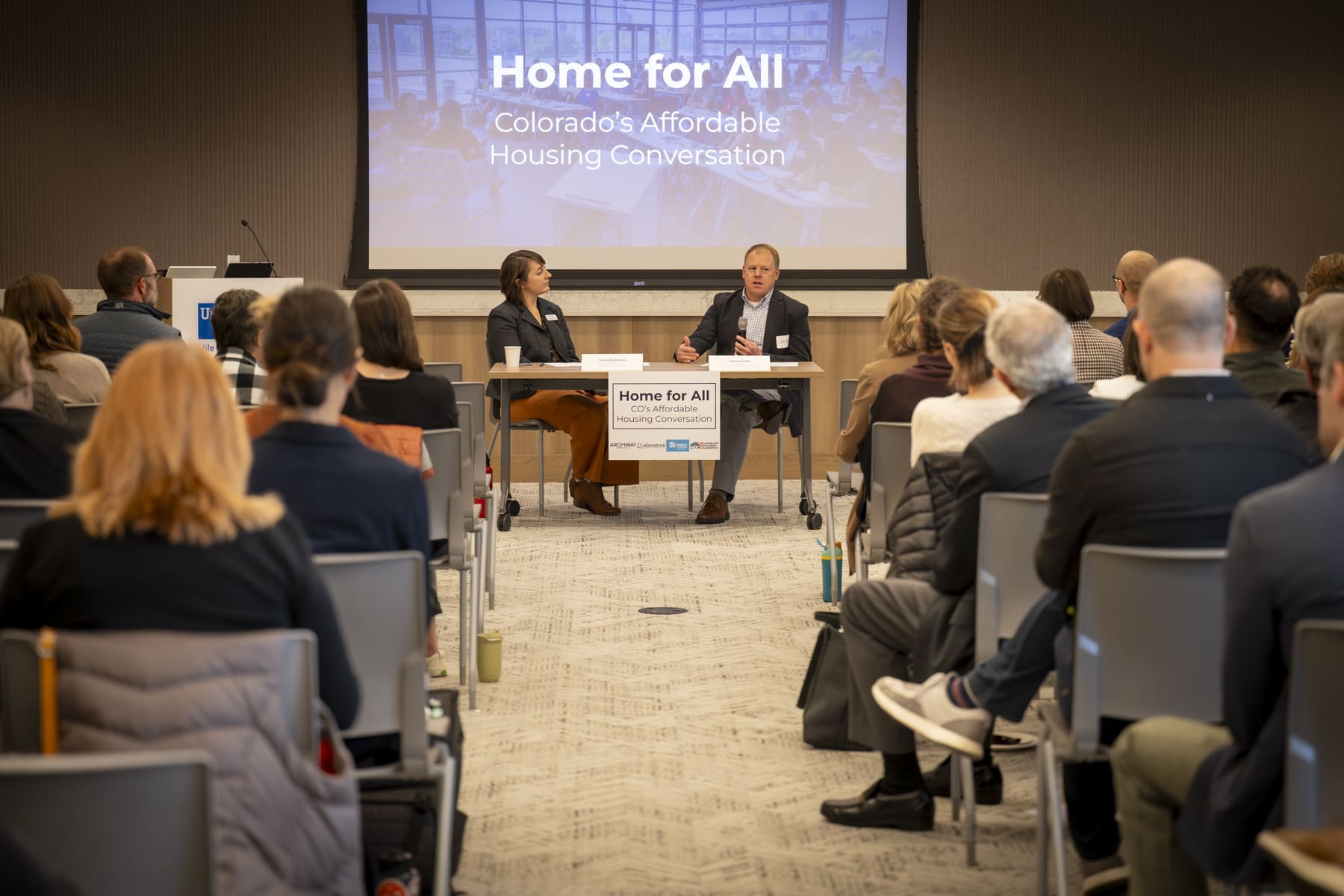
Last month, more than 100 of Colorado’s legislative officials, funders, developers, advocates, and community members joined Archway Communities, alongside the Neighborhood Development Collaborative, Elevation Community Land Trust, and Habitat for Humanity of Metro Denver, for a candid conversation about the state of affordable housing in Colorado. The mood was optimistic, but urgent—we need to address Colorado’s housing crisis with creativity and collaboration, and we need to do it now.
This year’s roundtable, Home for All: Colorado’s Affordable Housing Conversation, arrived at a critical moment for Colorado. The need is greater than ever, with 89 percent of Coloradans saying the cost of housing is a serious or very serious problem, according to the Colorado Health Foundation’s 2025 Pulse Poll. And for the first time, politics and government were the number one concern for residents of our state. Why does that matter? Affordable housing, how to fund it and how to build it, live at the intersection of those two areas.
In 2025, Colorado lawmakers reduced the State Housing Development Grant fund from its peak of more than $95 million to $53 million. Looking ahead to 2026, the state is bracing for a one-time $110 million cut to Proposition 123, a voter-approved resource and a critical tool for creating and preserving affordable homes. Combined with federal grant reductions, the landscape for financing new housing is more precarious than it’s been in more than a decade.
These fiscal realities are forcing legislators into increasingly binary decisions about which programs continue to be funded and which ones are put on pause. But for too many Coloradans, the need for affordable housing can’t wait out these budgetary constraints. Despite these obstacles, our panelists remained optimistic because they know affordable housing works, and Colorado has the momentum to keep building it. Recent focus from the public and elected officials, paired with significant public investments, has narrowed the state’s shortage of affordable units from 140,000 to 106,000.
While the need is still daunting, this progress demonstrates what is possible when public, private, and mission-based partners align resources and remove barriers. Our state has a reputation for being pragmatic and solutions-oriented, and that strength was on full display throughout our discussion last month.
We also have strong data proving that supportive services reduce homelessness, improve health outcomes and stabilize families. According to this year’s Community Needs Assessment conducted by Archway, 39% of households were experiencing homelessness immediately before moving into Archway housing, and the average time residents have lived at Archway is 4.1 years. We have committed developers and mission-driven organizations ready to deliver high-quality housing. And most importantly, we have communities across the state demanding action.
The panel urged both industry leaders and residents to communicate clearly and consistently with lawmakers about what is needed to keep Colorado’s housing pipeline moving. Whether it’s advocating for restored funding, encouraging zoning reform or championing development for people who need housing most, this feedback matters to the people making decisions about our state.
This is especially important as federal and state funding fluctuates. When dollars tighten, it becomes even more essential that decision-makers hear directly from those of us building and operating affordable communities and from the Coloradans who rely on them.
Of course, no single organization or sector can solve Colorado’s housing crisis alone. But together, we can influence policy, expand production, preserve existing homes and shape systems that meet the needs of families, seniors and individuals priced out of our growing state. And in doing so, ensure Colorado remains a place where every person, regardless of income, has the stability, dignity, and opportunity that a home provides.
Katie McKenna is a member of Archway Communities’ Real Estate development team, where she works to advance development projects to support health and affordable communities throughout Colorado. Katie has expertise in housing policy, community-based leadership development, organizational sustainability, affordable multifamily development, affordable homeownership, and community land trusts. Most recently, Katie worked in the Rocky Mountain Market at Enterprise Community Partners. She graduated from Wake Forest University with a Bachelor of Arts, and from the University of Denver Daniels College of Business with an MBA.