

By Micah Giardetti, principal, Design Workshop,
It’s early morning and the sun hasn’t yet risen. I can hear the furnace kick on as I layer upthermals, heated gloves and insoles, ski helmet, winter goggles, and a parka knowing the ride ahead will be cold. As I pedal east, my breath hangs in the air and the first light filters through the frost‑covered branches, and in that moment, I feel alive. For a growing number of Denver metro residents, this feeling is becoming familiar. What was once considered a fair‑weather amenity has quickly become an essential part of how people move through our city, and the upgrades made over the past few years have transformed the year‑round riding experience.
I’ve biked to work nearly every weekday for the last 10 years, including during the winter months. It’s about 14 miles r/t and the journey traverses Berkeley, the Highlands, Platte, the Cherry Creek Trail, and downtown streets, representing a true urban transect through the city. My route contains every type of bicycle infrastructure imaginable, including on-street bike lanes, sharrows, multi-use trails, and protected bike lanes. Observing how these strategies function over time has given me a clearer understanding of their operation and performance, insight that’s especially valuable in my work as a landscape architect focused on urban design, mobility planning, and the design of new communities.
In practice, I’ve been a major proponent of protected bike lanes (when the bikeway is separated from the travel way). This typology has become a priority in transportation planning nationwide over the past few decades. Research shows that, when installed as part of a connected network, protected lanes (the ‘Dutch’ model) are associated with significant increases in ridership and measurable safety benefits. Riding in the Netherlands is serious. Cyclists take their role seriously, and the infrastructure reflects that. Cars have a defined space, pedestrians have theirs, and the separation for bicycles and other rolling modes is unmistakably clear.
In recent studies in New York and D.C., some corridors have seen weekday bicycle volumes grow by more than 50 percent implementing protected bike lanes, alongside reductions in vehicle and rolling mode conflicts. Perceived safety among both cyclists and nearby residents also increases. The rise in ridership brings added public health benefits, as more people choose to get out of their cars and onto two wheels.
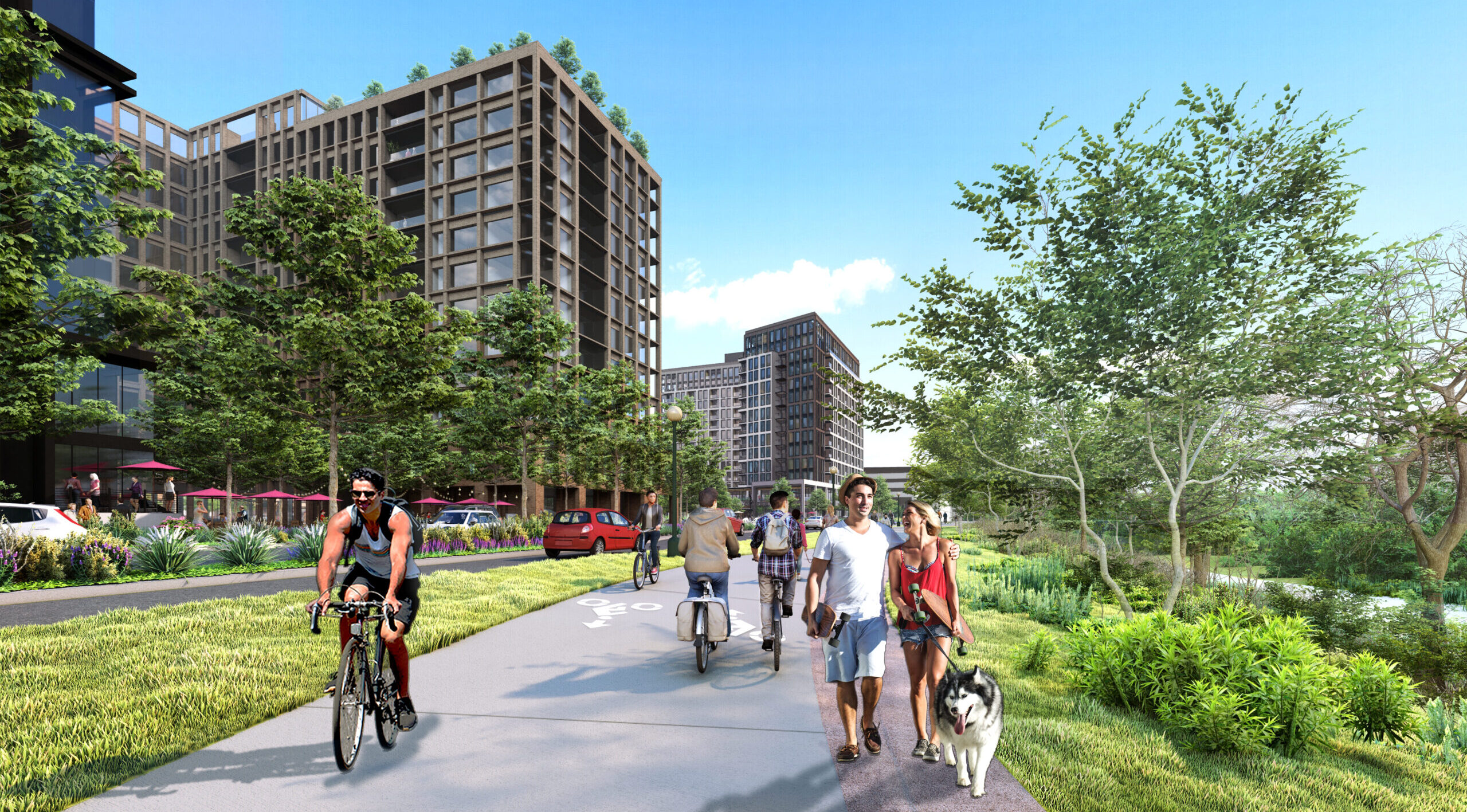
Our Design Workshop team is actively adding to this movement in Denver, including our most recent work implementing back-of-curb protected bike lanes along the south edge of the new Cherry Creek West project.
Denver’s Department of Transportation & Infrastructure (DOTI) has embraced protected facilities through its Vision Zero and Denver Moves initiatives, which focus on safer streets and expanded mobility options. Protected lanes are changing how right-of-way is allocated in the urban core. As Denver continues expanding its bike lane network, it’s been great to see riders using on‑street protected lanes, especially in winter, which shows that thoughtful refinements in design and operations can make the system even more available and consistent year‑round.
For a city committed to year‑round mobility, strong winter performance is essential. When facilities remain reliable during our coldest months, we maximize both their value and their return on investment. In my experience, nuance with their design and operation is key. When protected bike lanes are between the curb and parked cars, winter drainage can be an operational quagmire. As snow accumulates in the buffer strip, melts, and then freezes, the lanes become icy and unusable, creating dangerous conditions, especially in the evenings and early in the morning. This can be mitigated operationally by careful street sweeping of the bike lane and the use of salt, but ultimately, it is best addressed through design. Where possible, bike lanes (called cycle tracks) should be back-of-curb in our climate, as a best practice. If in the roadway, protected bike lanes need to have an integrated drainage strategy that accounts for snow accumulation and freeze-thaw cycles.
Denver’s commitment to expanding its bikeway network is consistent with national best practices and local policy goals. Protected lanes are an essential part of a multimodal system that supports denser development and decreases reliance on single-occupancy vehicles. The next phase of progress, however, is not simply adding more miles. It is about making sure those miles operate safely, clearly, and consistently, in February as well as on those mid-summer days.
Winter Bike to Work Day this February 13, 2026, provides a reminder that infrastructure that performs under the toughest conditions generates trust. For developers, employers, and city leaders, that trust translates into stronger districts, enhanced accessibility, and lasting resilience. Protected bike lanes are a smart investment. With thoughtful refinement and climate-responsive operations, we can fully deliver on their promise as reliable, year-round infrastructure for our growing city. As Denver is an example for cities nationwide seeking to build safer, healthier, and more accessible communities.