

By Katie Rapone,
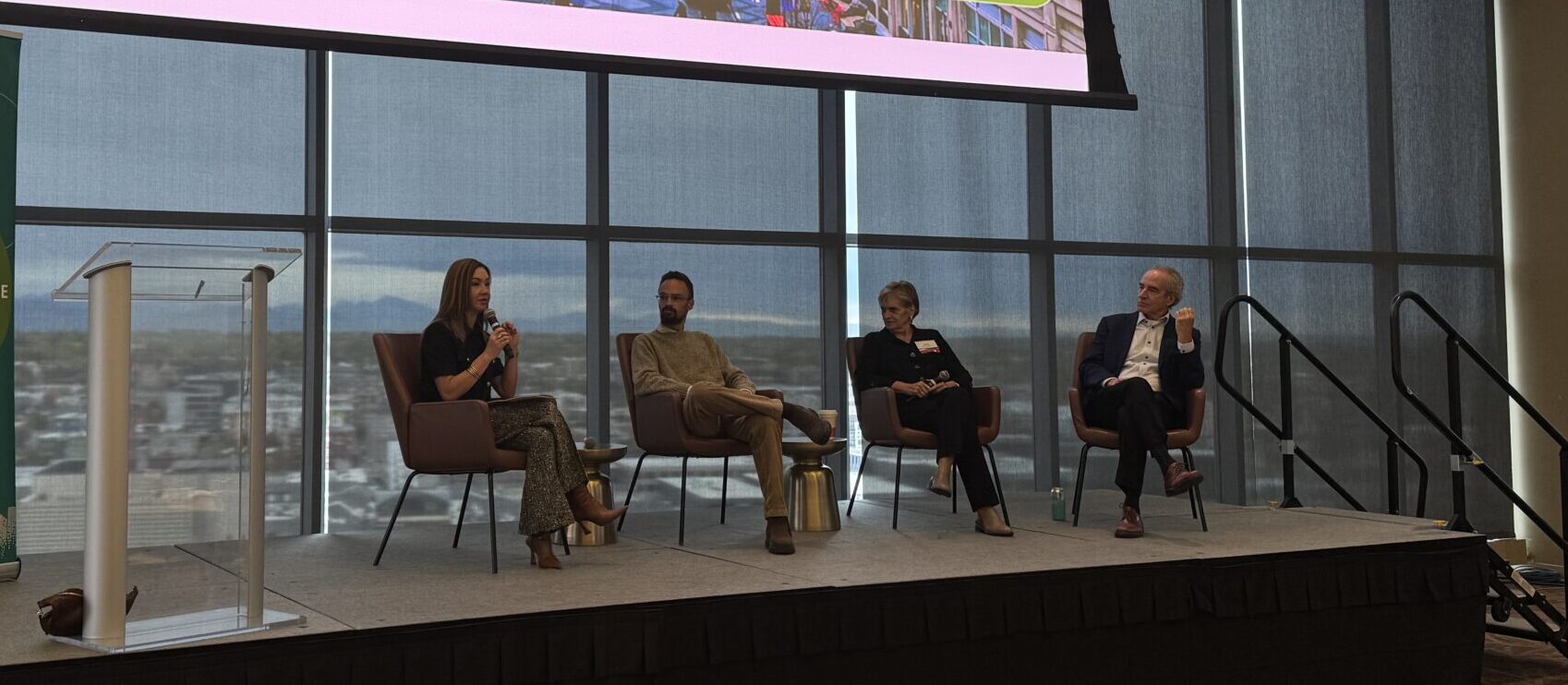
Downtown Denver’s revitalization will require more than converting vacant office buildings into apartments, according to industry leaders who discussed adaptive reuse, redevelopment challenges and the need for additional housing and neighborhood amenities at the Urban Land Institute’s Office to Residential: Beyond the Conversion breakfast series, held Oct. 22 at DaVita Marketplace in downtown Denver.
The panel examined how financing, regulatory hurdles and investment in amenities such as retail and green space could shape downtown’s transition toward a more residential, mixed-use environment. Speakers included Kourtny Garrett, president and CEO of the Downtown Denver Partnership; Asher Luzzatto, president of The Luzzatto Company; Sue Powers, president of Urban Ventures; and Bill Mosher, former chief project officer for the City and County of Denver.
Key takeaways:
1. Downtown Denver must evolve, not return to its past
- Denver has navigated downtown economic downturns before. Panelists referenced the oil and gas crisis and office market collapse of the 1980s, when five department stores closed in a single year and downtown office vacancy reached approximately 45%.
- Past recovery required a shift in mindset. Rather than trying to recreate the downtown that existed before the downturn, civic and business leaders focused on bringing people back into existing buildings and finding new uses for underutilized space.
- The current challenge calls for adaptation, not a return to the status quo. Panelists said downtown must evolve into a more mixed-use, neighborhood-oriented district that supports residents, businesses, jobs and cultural activity.
“We’re not going to be what we were before, and we just need to kind of get over it.” — Sue Powers
2. Office vacancy is not the only measure of downtown health
- Panelists agreed that office vacancy rates alone do not adequately measure downtown’s economic and social vitality.
- Rather than focusing exclusively on filling vacant offices, panelists advocated exploring residential conversions, creative uses and other opportunities to activate underutilized buildings.
- Other measures of downtown health should include residential population, pedestrian activity, visitation, conventions, business openings and the availability of amenities.
“Fill it up with jobs? Absolutely. Fill it up with residential? Absolutely. Fill it up with other creative and other uses.” — Bill Mosher
3. Adaptive reuse presents a major opportunity
- Asher discussed an approach to real estate that treats buildings as flexible platforms for culture, community and everyday life rather than assets designed for a single use.
- Some existing buildings can be converted to residential use at 50% to 60% of the cost of new construction, according to Asher.
- Panelists emphasized evaluating buildings individually before considering demolition, particularly given today’s high construction costs and the potential to repurpose existing infrastructure.
- Potential future uses could include housing, creative workspaces, galleries and other community-oriented spaces. Vertical farming and data centers were also mentioned as possible uses for certain properties.
“For us, it’s looking at what we have physically in a building and saying, how do we both remake this building for residents, but also allow it the freedom to become something different in twenty or thirty years.” — Asher Luzzatto
4. Financing tools could help make conversions viable
- The Downtown Development Authority (DDA) was highlighted as a potential source of financing for projects that might otherwise struggle to secure funding.
- Asher said DDA financing can help bridge the gap between senior debt and more expensive mezzanine financing, while generating benefits for downtown through new residents, sales tax revenue and increased economic activity.
- Loans are expected to be repaid, with his current projections calling for repayment within five years, allowing the DDA to reinvest the funds.
- Historic tax credits could become increasingly important for buildings constructed from the 1950s through the 1970s as more properties become eligible for historic designation.
- Panelists also called for entrepreneurial investment and creative capital strategies to support projects that traditional institutional investors might avoid.
5. Regulatory barriers remain, but permitting has improved
- Panelists said Denver’s development review and permitting processes have improved, citing more responsive city staff and efforts to address backlogs.
- However, overlapping regulations, lengthy approvals and layers of fees continue to add complexity and cost to development.
- Sue Powers emphasized the need for better coordination between city and state requirements, particularly for affordable housing approvals under Proposition 123.
- Asher said his team expects to secure permits for the Denver Energy Center conversion by late 2026, following its acquisition in December 2025. He described the timeline as evidence that projects can move efficiently through the process.
- Panelists identified construction-defect laws as a priority for reform, arguing that current liability concerns discourage condominium development and limit opportunities for homeownership.
6. Downtown needs more residents, housing options and everyday amenities
- Panelists emphasized that downtown must become a neighborhood where people can live, work and spend time outside of business hours.
- Affordable housing, workforce housing and attainable homeownership options were identified as important to creating a more inclusive downtown.
- Asher cited a full-service grocery store, child care and additional green space as priorities for attracting residents and families.
- Panelists also discussed the potential for more parks and public spaces downtown.
7. Small businesses could benefit from current market conditions
- Panelists stressed that independent businesses and local entrepreneurs should play a central role in downtown’s recovery.
- One speaker cited approximately 100 new ground-floor businesses opening downtown over the preceding 14 months, while noting that business closures remain a challenge.
- Asher encouraged small businesses to consider taking advantage of favorable leasing conditions, including negotiating longer lease terms with predictable rent increases.
- Panelists also highlighted the importance of local retail, small-business assistance, tenant improvement support and financing programs.
- National retailers may help stabilize the market, but speakers said they should complement rather than displace locally owned businesses.
“This is the time for small business to actually take advantage of the market.” — Asher Luzzatto
8. Denver’s long-term strengths remain intact
- Panelists pointed to Denver’s outdoor lifestyle, sunshine, access to the natural environment, cycling culture and entrepreneurial spirit as enduring advantages.
- They also stressed the importance of restoring civic pride and encouraging business leaders to invest in downtown rather than retreat from the market.
- The transformation of the Central Platte Valley and the development of Denver Union Station were cited as examples of what sustained investment, community engagement and long-range planning can accomplish over decades.
- Speakers urged the business community, property owners, policymakers and residents to remain engaged in downtown’s future, recognizing that meaningful change will take time.
When asked what sets Denver apart and will drive its future growth, Mosher pointed to the city’s lifestyle, entrepreneurial culture and ability to chart its own course despite its relative geographic isolation.
“It’s because we’re Denver; we’re isolated, we have a pioneering spirit, and we are gonna make ourselves into something that we maybe shouldn’t be, but we have pride.” — Bill Mosher.
Join ULI Colorado’s Breakfast Series for timely discussions on issues shaping the built environment. Open to members and nonmembers, these events bring together industry leaders and professionals for networking, insights, and engaging conversation with Colorado real estate and land use professionals.
The next ULI Colorado Monthly Breakfast Series will be held November 19 from 8am-10am at Davita Market Place, 2000 16th St., Denver, and focused on The Future of Burnham Yard. Register here.