

Every day, a CEO somewhere narrows a list of cities down to three. On the night of October 8 in Denver’s RiNo Art District, the people who build those lists told Metro Denver exactly where it stands.
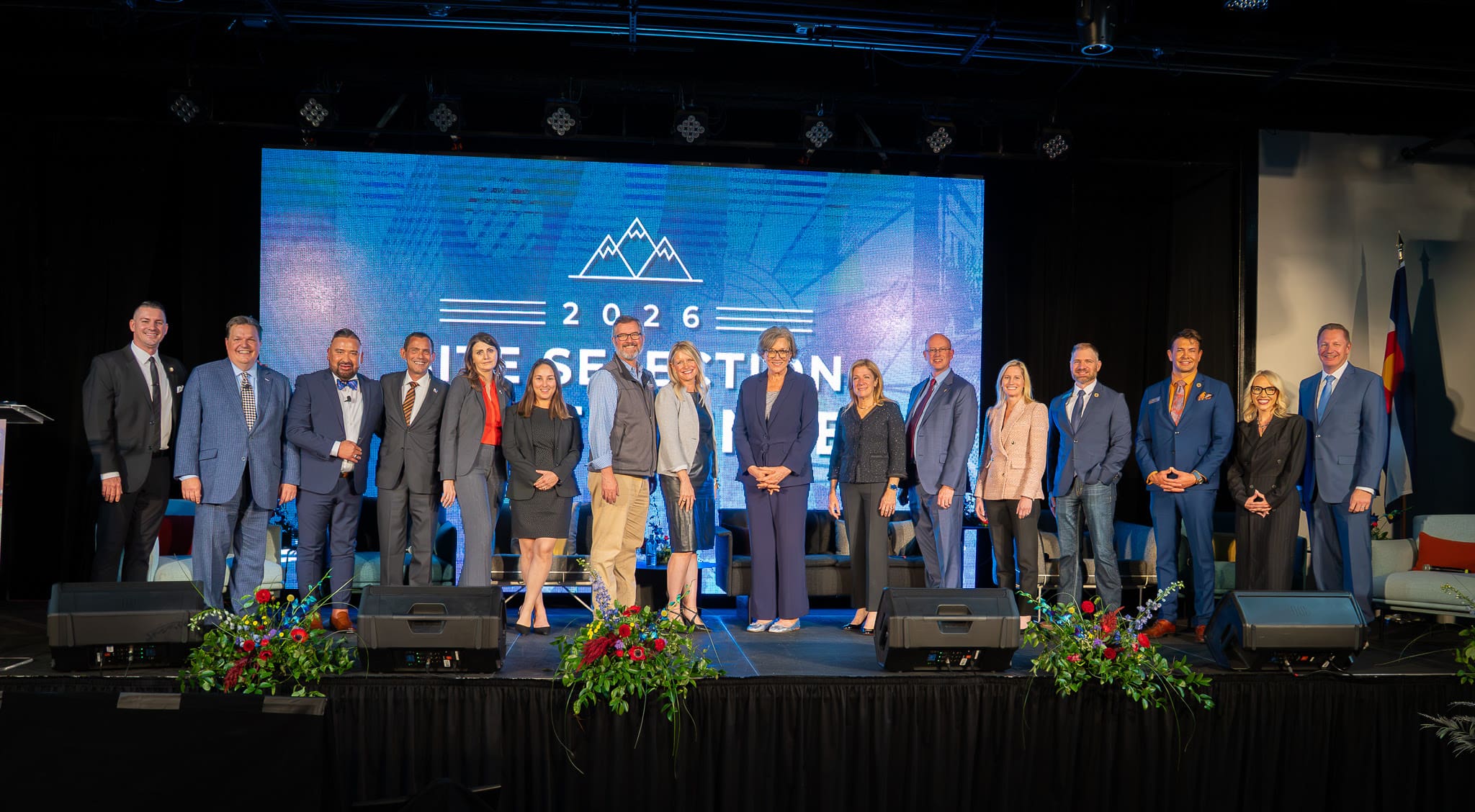
Seven site selection consultants and corporate location executives, advisors on Fortune 100 to Fortune 1000 relocation and expansion decisions, closed out the Metro Denver Economic Development Corporation’s (EDC) 2026 Site Selection Conference with a candid panel at the annual Site Selector Feedback Dinner. Over three days, the region pitched its airport, water and power, workforce, industry clusters, and regional collaboration. On Thursday, they had the microphone.
“Our site selectors were pitched on the value proposition of Colorado’s local communities in buses, boardrooms and breakfast buffets,” said J. J. Ament, president and CEO of the Denver Metro Chamber of Commerce, who moderated the panel. “Tonight, the tables turn. They talk, we listen.”
The panel featured Jon Arita, national director of logistics at Terracon; Darin Early, vice president of U.S. strategy, execution & business development at Philip Morris International; Blake Jannett, manager of location investment, credits & incentives at EY; Enrique Monge, capabilities & insights specialist at McKinsey & Company; Kim Moore, executive managing director at Newmark; Denise Mullis, senior vice president and partner at J.M. Mullis; and Mike Mullis, president and CEO of J.M. Mullis.
“No one is better positioned to tell us how we’re doing than the people who advise companies on where to invest in jobs, growth and lifestyle,” said Raymond H. Gonzales, president of the Metro Denver EDC and executive vice president of the Denver Metro Chamber. “This week, they heard from us about why Colorado is best for business. Tonight we handed these advisors the microphone, because their honest feedback tells us what it takes for this region to compete for the next generation of jobs and investment.”
The verdict: Metro Denver’s regional teamwork is something site selectors rarely see anywhere in the country, but in a fight for projects against aggressive rivals at home and abroad, Colorado has to compete with more hunger than ever.
A region that plays as one team. Panelists returned again and again to the collaboration among nearly 130 communities across 12 counties and to how welcoming the region is to newcomers, a critical factor when a company is moving its people.
“The ability for this community to act cohesively is singularly unique in this country,” said Darin Early, vice president of U.S. Strategy, Execution & Business Development at Philip Morris International.
A wake-up call on competition. The panel was direct about where Colorado has room to grow, warning that competing states are more aggressive than ever and that the real competition is global.
“Colorado was not hungry for this project,” said Denise Mullis, senior vice president and partner at J.M. Mullis, recalling a recent competition. “Those southeastern states, let me tell you, they do not back off. You’ve got to fight. You’ve got to remember your competition is aggressive.”
“It’s time for a rebirth of this state to recognize the competition is not next door. It’s everywhere. It’s global,” said Mike Mullis, president and CEO of J.M. Mullis.
Connectivity and site readiness. Panelists called Denver International Airport an irreplaceable asset that must be maintained. They said site readiness now goes well beyond acreage and a utility provider to what lies beneath the soil, the loads a site can handle, and its entitlements.
“Water, power, and sewer are all the top things that nobody has,” said Kim Moore, executive managing director at Newmark.
Building the talent pipeline. Panelists praised the region’s K-12 career pathways and investment in future talent, while naming housing costs as a threat to keeping graduates here.
“You clearly have the talent,” said Enrique Monge, capabilities & insights specialist at McKinsey & Company. “But one key thing is retaining that top talent and not losing that top talent that’s graduating from your institutions. Housing is a big piece.”
Incentives and policy. Panelists said refundable or transferable tax credits are now table stakes against competing states, and they pointed to tools like a sales tax exemption for large-scale data centers.
“We’ve seen projects lose just because the incentives package isn’t as strong,” said Blake Jannett, manager of location investment, credits & incentives at EY. “We’ve also seen the wins in the state from localities utilizing the levers that they have.”
Advice for Colorado leaders. In a closing lightning round, the panel urged leaders to keep the companies already here, protect the region’s lead in quantum, speed up permitting and keep investing in relationships with site selectors.
“In order to win something, you have to have something to sell,” said Jon Arita, national director of logistics at Terracon. “Really understand what you have. You have to make it easy to pick you.”
“We heard your feedback loud and clear,” Ament told the site selectors. “This kind of feedback directly shapes our priority work at the EDC and Chamber. Our north star is Economic Empowerment for Every Coloradan.”
A Win for Colorado, Announced in the Room
After a week of asking site selectors what it takes to win projects in Colorado, the region showed them one. Gov. Jared Polis and the Colorado Office of Economic Development and International Trade used the dinner to announce that Lockheed Martin will expand its Space division operations in Douglas and Jefferson counties, creating up to 1,250 jobs over the next four years.
The evening also honored the late Tom Clark, who founded the Metro Denver EDC nearly 40 years ago, with the inaugural Tom Clark Legacy Award, presented to Phil Washington, retired CEO of the Denver International Airport. The EDC announced it will commission a mural in RiNo in Clark’s honor, with a goal of debuting it by the end of 2027.