
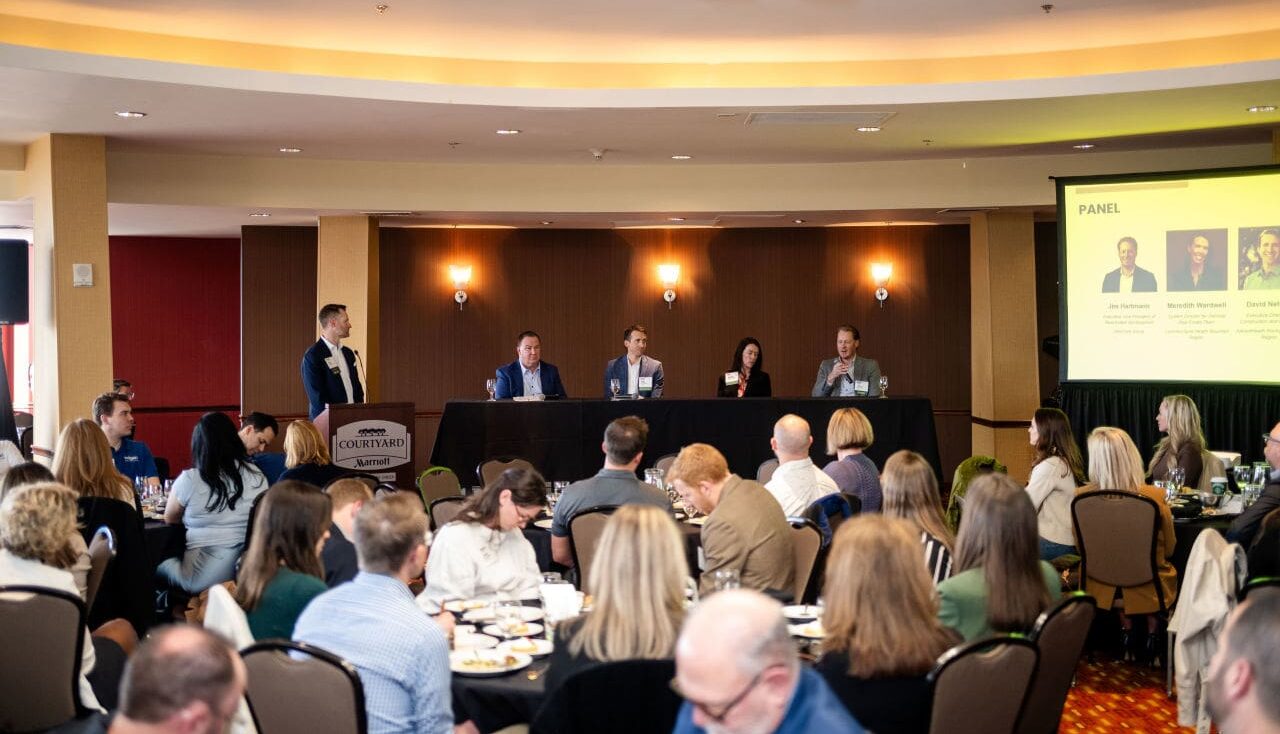
Healthcare design and construction across Colorado continues to evolve at a rapid pace, shaped by cost volatility, labor shortages, shifting reimbursement models, and long-term operational demands. Those themes took center stage at Building with Heart: Colorado’s Healthcare Outlook 2026, a February panel hosted by SMPS Colorado and CAHED.
Held before a sold-out audience, the event brought together healthcare system operators, commercial real estate professionals, and design and construction leaders to discuss where the market is headed and how project teams must adapt.
The discussion was moderated by Conor Ryan, director of business development at Layton Construction, and featured:
- Mike Chihoski, vice president of facilities, design & construction, UCHealth
- Meredith Wardwell, system director of CommonSpirit’s National Real Estate Team
- Jim Hartmann, executive vice president of real estate development, Nexcore Group
- David Nelson, executive director of construction and facilities, AdventHealth
Cost Certainty Driving Delivery Innovation
Rising construction costs and ongoing market volatility have accelerated a shift away from traditional project delivery methods in pursuit of greater cost control and predictability.
“Anything is better than Design-Bid-Build” Chihoski remarked, a comment that underscored the broader sentiment that more collaborative models are better suited to today’s environment.
Panelists discussed the growing use of Target Value Delivery, Integrated Project Delivery, Design-Assist, LEAN practices, and real-time estimating. Early engagement of contractors and trade partners, transparent cost modeling, and shared risk frameworks are increasingly seen as essential tools to maintain feasibility in a tightening capital landscape.
For owners and developers, the priority is clear: bring the right partners to the table earlier, align expectations from the outset, and build teams capable of navigating uncertainty together.
Capital Strategy, Reimbursement & the Shift to Outpatient
With reimbursement reform and federal legislation once again entering the national conversation, panelists addressed how changing financial structures are influencing capital allocation and real estate strategy.
The continued expansion of outpatient facilities remains a major trend, driven by patient convenience, lower-cost delivery models, and decentralized care strategies. However, systems are approaching capital deployment with increased scrutiny.
UCHealth shared that it is actively investing in Colorado real estate, with more than 30 land-banking deals in place each aligned with short-, long-, or future-use strategic plans. Nexcore Group and AdventHealth discussed prioritizing feasibility studies, due diligence, and master planning efforts to “future proof” projects before capital is committed. CommonSpirit Health echoed that approach, noting the organization is “doubling down on planning and strategy.”
The message for the CRE community is this: healthcare systems are still investing but they are doing so with long-term operational sustainability at the forefront.
The Workforce Challenge: Beyond Construction
A recurring theme throughout the discussion was labor not only within construction, but across healthcare operations.
Panelists acknowledged an industry-wide imbalance: more projects and demand than there are designers, builders, clinicians, and operators to support them. This shortage is reshaping timelines, increasing pressure on Planning, Design & Construction teams, and influencing how projects are phased and prioritized.
Yet the conversation moved beyond workforce numbers to operational realities.
“The easiest part of the job is building the hospital,” David Nelson of AdventHealth commented. “The real work begins after. There is no ‘soft’ opening…from day one we have people coming in the doors and needing help saving their lives.”
For A/E/C professionals, that statement reframes project success. Healthcare facilities must function at full capacity immediately upon opening, making activation, staffing planning, and operational coordination as critical as the physical construction itself.
Designing for Wellness & Long-Term Operations
An audience question raised an important issue: with rising staff burnout and workforce shortages, are healthcare facilities being designed to support employee wellness?
The panel agreed that intentional design for respite and mental health is increasingly part of the conversation but must be balanced with financial constraints. Break rooms and respite areas must truly function as spaces of recovery, not overflow workspaces.
At the same time, panelists cautioned against overdesign.
“Design to fit our needs first, not to win the design award,” one speaker advised. Owners are seeking thoughtful, right-sized solutions that prioritize operational efficiency.
What Healthcare Owners Value in Partners
When asked what distinguishes strong design and construction partners, the panelists were direct – expertise and candor matter.
“You are hired to be a subject matter expert,” one panelist emphasized. The strongest teams do not always agree, they provide informed guidance and respectfully challenge assumptions when necessary.
Transparency, cost discipline, operational understanding, and long-term thinking were cited as essential traits.
About SMPS Colorado
The Society for Marketing Professional Services (SMPS) Colorado was founded in 1983 and is the largest chapter nationwide, representing more than 300+ members. The chapter’s membership includes a mix of principals, business development officers, and marketing professionals who are focused on developing relationships and generating revenue for their companies. SMPS Colorado is a not-for-profit association dedicated to enhancing its members’ abilities to find and win business for their firms. The Colorado chapter offers events in the Denver, Fort Collins, and Colorado Springs areas, including monthly luncheons and forums focused on every level of professional development. View the event calendar here.
About CAHED
The Colorado Association of Healthcare Engineers & Directors (CAHED) is a nonprofit professional organization dedicated to advancing healthcare facilities management across Colorado. CAHED brings together healthcare facility leaders, engineers, construction professionals, and industry partners to promote education, collaboration, and innovation in the built healthcare environment. Through educational programming, conferences, and strategic partnerships—including alignment with ASHE—CAHED supports best practices in healthcare design, construction, and operations.