


By Amy Aldridge, partner, TRE
There’s a lag built into commercial real estate that most people outside the industry don’t think about. By the time a signed lease shows up in a quarterly report, the driving decisions behind the lease—the space goals the tenant had, the work policies they were trying to shape, or the market conditions they were adapting to—could be anywhere from 12 to 24 months old. In that way, the data that drives the stories we read every day, those being told about Denver’s office market, is really, at times, reflecting sentiments that were occurring in 2025, even sometimes 2024. For five years, dealmakers in the office market operated under “survive to ’25,” and that hunker-down mentality showed up in every tenant conversation we had. But by last winter, that guardedness had started to fade from pushing out renewals to asking what a seven-to-10-year commitment could look like in the building.
If 2025 was the end of an era of hesitance, 2026 is shaping up to be the year of transacting.
I’ll be the first to admit the phrase carries some boldness for a market that still has a nearly 29% vacancy rate, but what gave the instinct weight was hearing similar sentiment nationally from the capital side of the industry. More lenders are returning to the office space and there’s a broadening consensus that transaction volume will climb significantly this year. That kind of conviction nationally makes it clear that what we’re feeling locally is part of something bigger.
What is the office if not the people?
When hybrid work was adopted as the happy medium between working from home and coming in five days a week, many firms assumed fewer days at the office meant they could cut their footprint in half. It made sense in theory to strip out assigned desks, adopt hoteling models and design for maximum flexibility with minimum square footage. In practice, it created a new problem: employees would walk into a floor of identical open workstations, spend time looking for a desk, get set up and then promptly move again to find a quiet place to take virtual calls with clients or colleagues. That kind of efficiency works on paper extraordinarily well, but designing so employees feel like guests in their own office can create friction and undermine the whole purpose of returning.
Today, many more employers have landed on a schedule of two to four days a week in the office, largely with dedicated desks and offices. These spaces are more attractive in drawing employees back because they feel ownership, they do not show up to a floorplan of sameness where they are transient visitors. The combination of hybrid office schedules with a footprint shaped by meaningful engagement has returned space requirements closer to pre-pandemic levels than early forecasts suggested, and it’s one of the key reasons lease commitments are starting to resemble what we saw before 2020.
Moving past optimistic anomalies
Instinct without data is just optimism, and while the late 2025 data gave us the beginning glimpses of recovery, the Q1 data served as a reminder that recovery is not linear.
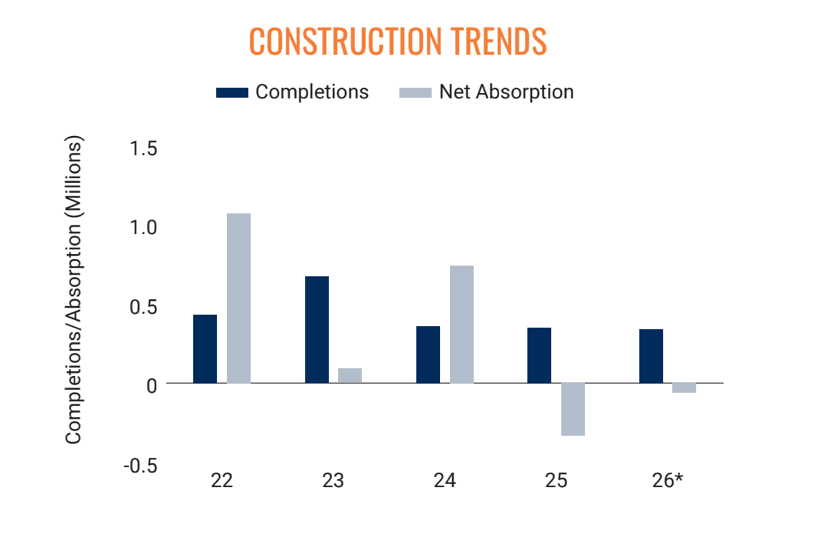
The fourth quarter of 2025 was the first quarter of positive net absorption since early 2022. Now, with the most recent numbers, we’re seeing about 159,000 square feet of negative net absorption, according to CBRE reporting. While the total vacancy rate had its first post-pandemic decline at the end of 2025, there was a slight increase to 28.7% in Q1. The pace of deterioration has slowed materially compared to the last several years. At the same time, sublease availability continued declining as more spaces rolled back into direct inventory and leasing activity remained relatively steady.
None of this data points to full recovery anytime soon, but it does mark a genuine shift from the trajectory of the last several years: a market no longer in freefall. In fact, more than 50% of leases signed this quarter were either new or expansions, a good indicator in a market that has long been largely renewals. Denver’s office sector has shifted into a phase defined less by broad recovery and more by active repositioning and selective demand.
Downtown, the story is even more nuanced: while vacancy hovered around 39%, Downtown had 543,000 square feet of leasing activity, the highest of any submarket. Additionally, investment activity remained active despite significant pricing resets, including the $47.5 million acquisition of Denver Place downtown, a sharply discounted basis, one difficult to imagine a few years ago. In the past several quarters, we have also seen many largely vacant buildings being converted to residential use, reshaping the inventory picture in ways my colleague, Brian Craig, spoke to recently. And the energy sector continues to play an outsized role in downtown leasing activity. While energy is a bellwether in office markets from Houston to Calgary, those commitments tend to be large, long-term blocks that can pull the rest of Denver’s diversified economy along with them.
The Southeast submarket also proved that stabilization isn’t limited to one corridor, posting 402,000 square feet of positive net absorption. This was its second consecutive quarter of positive net absorption following a previous seven consecutive quarters of negative.
Rebound economics
Our recovery largely mirrors trends we’re seeing nationally. In 2025, lenders issued $125.6 billion in commercial mortgage-backed securities—a 21% jump and the highest volume since the Global Financial Crisis, with about a quarter of that tied to office properties. Nearly $600 billion in commercial real estate debt is coming due through 2026, which means building owners who have been sitting on expiring loans and hoping for better conditions will finally have to act. Investors looking for deals and owners being forced to the table at the same time is how we settle years of deferred decisions.
Denver rebounded more slowly than New York or San Francisco and has had a larger delta between asset classes and locations. However, our office market is further along than other mid-sized markets facing similar headwinds. Austin’s vacancy stands near 25%, and it has only just recorded its first positive absorption after years of tech-driven overcorrection, while Seattle’s downtown vacancy sits closer to 35% as leasing started to firm up for the first time since 2021. The Mile High City fared well, landing squarely in the middle of that peer group despite a larger delta between asset classes and locations. You can see it in the spread between older buildings like the Lincoln Crossing towers downtown, which is still trading at $21 per square foot, and stabilized properties like The Citadel in Cherry Creek, which is selling at $397 per square foot and reaching 96% occupancy. The gap between those numbers says that the market hasn’t finished repricing.
Generosity has a shelf life
Landlords have been competing for a shrinking pool of active tenants for years, and the tenant improvement allowances and incentive packages on the table right now still reflect that reality. However, as vacancy tightens and leverage shifts, those terms may become harder to negotiate. Our view is that tenants have roughly eighteen months before the cycle tilts back, while companies already in the market will benefit most.
The industry spent many years reacting: to the pandemic, to rising rates, to remote work and an uncertainty that seemed to renew itself every quarter. The talk and walk now is forward-looking, specific and supported by signed letters of intent. Survive to ’25 did its job; it’s time to transact.
About the author: As a partner at TRE, Amy Aldridge has 20 years of experience in commercial real estate as a licensed broker. Amy drives the company’s continued growth through an integrated approach to brokerage services. Amy’s extensive experience closing complex and challenging transactions has provided her with the expertise to find creative solutions for virtually any client real estate need—a skill she empowers her team to continually develop.